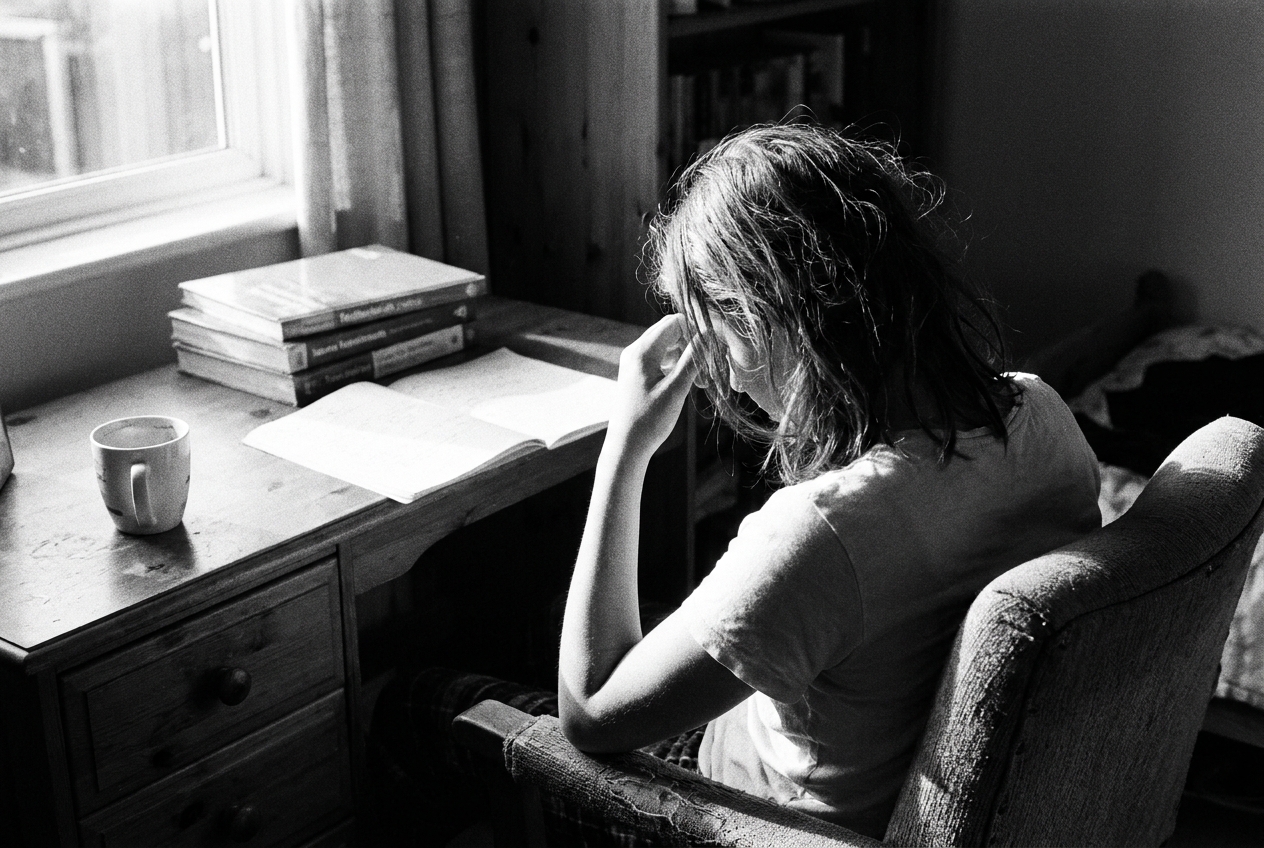
It is gone 7pm. Your daughter held it together all day, came out of school with a tight smile, and then the front door closed and it all came out: the tears, the slammed door, the "I'm so stupid". School says she is polite, hard-working, a little dreamy, nothing to worry about. You half-suspect ADHD, and you have been told girls do not really get it. Whether you have a diagnosis or just a strong hunch, you are in the right place.
Why it looks different in girls, and why that means it gets missed
ADHD in girls is under-recognised, not rare. The picture most parents are taught to watch for, the boy who cannot sit still and disrupts the class, is only one version of it. The official guideline the NHS works to says plainly that girls and women are referred less, diagnosed less, and misdiagnosed more (NICE NG87, 2018).
Girls more often have what clinicians call the inattentive picture. Daydreaming. Losing things. Careless slips in work she clearly understands. Slow to start, slow to finish, in a world of her own. The hyperactivity is still there, but it has often gone inwards: thoughts going at a hundred miles an hour, restlessness, talking over people, big feelings that arrive fast and hard. None of that climbs the furniture, so none of it lands as "a problem in class".
Then there is the bias in who gets flagged. When researchers show teachers the same set of symptoms and change only the name and pronoun, the "boy" is more likely to be referred than the "girl" (Young et al., 2020). And girls work hard to stay under the radar. Many become perfectionists or people-pleasers, copy the well-behaved children around them, and put two or three times the effort into looking like they are coping. That effort is called masking, and it is one of the main reasons referral comes late (Young et al., 2020).
Here is the number that makes masking concrete (Barclay, Sayal and Ford et al., 2025). The gap between the two figures below is the gap that lives in your kitchen. It is a recognition gap, not a prevalence gap.
The stereotype against how it more often shows in girls
The after-school crash: why home sees what school doesn't
Holding it together through a school day costs her something, and home is where the bill comes due. A full day of sitting still, reading the room, keeping up and keeping it in drains the tank. The moment she is somewhere safe, usually with you, what she has been holding back comes out as a meltdown, a shutdown, irritability or tears.
This is why "no concerns at school" and "falling apart at home" sit side by side so often. Parents get disbelieved on exactly this point. The two pictures are not a contradiction. She is the same child, before and after the mask comes off. The teacher sees the "before". You see the "after".
It is worth decoding the school line, because you will hear it a lot. Schools will often say "she's lovely, no problems here". What that usually means is that she is masking well enough that the struggle stays invisible until twenty past three, not that there is nothing going on. That is not the school being difficult. It is the whole point of masking: it works, right up until it doesn't.
One practical thing helps more than any argument. Keep a short home log: the date, what set her off, what she did, and what helped her come down. A fortnight of that is evidence the school does not have, and it makes any later referral much stronger. You are not building a case against your daughter. You are recording the part of her day nobody else sees.

When it gets called anxiety instead
ADHD in girls is very often seen as anxiety, low mood, shyness or an eating problem first, and the ADHD underneath gets missed. Clinicians call this diagnostic overshadowing: one explanation arrives, fits some of the picture, and the search stops there.
The UK evidence on this is hard to argue with. Read that figure twice. The low mood got treated. The thing driving it did not.
Anxiety and low self-esteem can grow out of years of unmanaged ADHD, especially once the masking stops coping (Young et al., 2020). That tends to happen at secondary school, when the work gets harder, the social rules get more complex, and the strategies that carried her through primary quietly run out.
None of this is said to frighten you. It is said because recognition changes outcomes, and because the version where nobody looks underneath the anxiety is the version worth avoiding. If your daughter is talking about self-harm or you are worried about her safety, skip ahead to the help section at the foot of this article and act on it tonight.
What to actually look for
No single sign means ADHD. What matters is a lasting pattern, across more than one part of her life, that gets in the way of school, friendships or how she feels about herself. These are the markers parents most often recognise once they know to look.
Attention and organisation
- Chronic disorganisation: the bag, the bedroom, the schedule, one of them is always chaos.
- Forgetfulness and losing things, even things that matter to her.
- Time-blindness: ten minutes and an hour feel the same.
- Starting and finishing tasks is the hard part, not the thinking itself.
Emotions and friendships
- Big feelings that arrive fast, and a strong reaction to feeling rejected or left out.
- Friendships that burn bright then fall out.
- Perfectionism, and a harsh inner voice: "I'm stupid, I'm lazy, everyone else finds this easy."
Effort and exhaustion
- Homework that takes far longer than it should for a child who clearly understands the work.
- Tiredness out of all proportion to the day she has had.
Treat this as a recognition aid, not a diagnosis. A lot of these overlap with autism, and the two often travel together. If parts of this feel familiar but the social picture does too, it is worth reading the signs of AuDHD in women and, where demand-avoidance is in the mix, what PDA can look like in girls. Only a qualified clinician can give a diagnosis. Your job is to notice the pattern and get it in front of the right person.
Getting an assessment in 2026: the realistic picture
The standard NHS route starts with your GP, who can refer your child to community paediatrics or to CAMHS (the child and adolescent mental health service) for under-18s. Be specific. Describe what you see at home and how it affects her across different settings, not just how she behaves in class, because the home picture is the bit professionals most often miss in girls.
You may have read about Right to Choose, an NHS route in England that lets you ask to be referred to an approved independent provider, sometimes with a shorter wait. Be careful how you read that. As of early 2026, at least nine NHS areas (Integrated Care Boards, the local NHS bodies that hold the budget) have paused or capped Right to Choose ADHD and autism assessments, with some pauses running into 2026 (Special Needs Jungle, 2025; Pulse, 2025). It helps some families and is closed to others. It is a postcode lottery, so check your own area's current position and treat any waiting-time figure you read as something that goes out of date fast.
Here is the part that matters most while you wait. School support does not need a diagnosis. Schools have to make reasonable adjustments for a disabled child, and that includes ADHD, whether or not there is a formal label yet (Equality Act 2010, s.20). Support is meant to follow the graduated approach, a cycle of assess, plan, do and review, based on the need in front of the school, not on a diagnosis (SEND Code of Practice 2015, para 6.36 onward). Ask the SENCO (the teacher in charge of special educational needs) to start that cycle now.
One small point of accuracy if you are reading older guidance: since September 2024 the required qualification for a SENCO newly in post is the NPQ SENCO. The older NASENCO award is still respected, but it is the legacy qualification, not the current requirement.
This week, if you only do three things:
What the 2026 SEND changes mean for you
The law as it stands today has not changed. The SEND system runs on the Children and Families Act 2014, Part 3, and the SEND Code of Practice 2015. Education, Health and Care needs assessments and EHCPs (your child's legally binding support plan, the one the council writes and has to fund) are still in force, and you can still ask the council to assess (Children and Families Act 2014, s.36).
There is reform coming, and it is worth knowing the direction without reading too much into the timeline. The Schools White Paper, "Every child achieving and thriving" (February 2026), and the Education for All Bill that followed propose a statutory Individual Support Plan for every child with SEND, and would narrow EHCPs towards the most complex needs over the years to 2035. A consultation ran alongside it.
What that means for you in practice is reassuringly little, for now. The government has said there are no changes to EHCP support before September 2030, and that children who currently hold an EHCP are protected. Nothing about your daughter's rights changes overnight. If anything, the direction of travel is an argument to get her needs identified and written down now, through the graduated approach, while the framework you know is still the one that applies.
Where to get help and support
A missed diagnosis is not a parenting failure. The signs that get missed are missed by schools, GPs and clinics too, which is rather the point of this whole article. Recognising the pattern is the start of support, not a verdict on you.
For practical, UK information and a real person to talk to:
- ADHD UK and the ADHD Foundation, for parent-facing information and route guidance.
- YoungMinds Parents Helpline, 0808 802 5544, for parents worried about a child's mental health.
- Contact, for family support and free benefits checks.
If your child is in distress, struggling with her mental health, or you are worried about self-harm, please reach out tonight. Asking for help when you are this worried is one of the strongest things a parent can do.
- Samaritans. Call 116 123, free, any time, day or night.
- Papyrus HOPELINE247. Call 0800 068 4141, free, any time (for under-35s with thoughts of suicide, and for anyone worried about a young person).
- Shout. Text 85258, free, 24/7 text support if talking on the phone feels like too much.
- Or call 111 and ask for mental health support, available in most areas.
- In an immediate emergency, call 999 or go to A&E.
Where the figures and the law in this article come from:
- NICE NG87, ADHD: diagnosis and management (2018), on under-recognition in girls and women.
- Barclay, Sayal and Ford et al., JCPP Advances (2025), on the 1.6 to 1 unrecognised ratio against the 4 to 1 diagnosed ratio.
- Martin et al., Journal of Child Psychology and Psychiatry (2024), Welsh national records, on later diagnosis and antidepressant prescribing.
- Young et al., BMC Psychiatry (2020), expert consensus on females with ADHD, masking and misinterpreted internalising symptoms.
- Equality Act 2010, s.20 (reasonable adjustments) and Children and Families Act 2014, Part 3.
This article is general information, not a clinical or legal opinion. It has been reviewed by a qualified UK SENDCO but does not replace advice from your GP, your child's school, or a solicitor on your specific case.
About the reviewer

Emma Owen
Owner of The SEN Support Studio
Former Local Authority SEN Advisor & specialist SEN teacher · 6+ years across SEN
Emma has 6+ years' experience across SEN as a teacher, Local Authority SEN Advisor and Trainer, and specialist SEN teacher. She has supported families through EHCPs, Annual Reviews, and tribunals, as well as sensory deep dives and personalised SEN Support. She works daily with complex needs including Autism, ADHD, SLCN, and sensory differences, and offers clear, practical, and personalised guidance to help parents understand their child and take confident next steps.
Scope of review: Emma reviews Remarkable Minds's content on EHCPs, annual reviews, transitions, sensory support, and parent advisory topics. She does not provide legal advice on tribunal proceedings; for that, contact IPSEA or SOSSEN.
Reviewed by Emma Owen ·