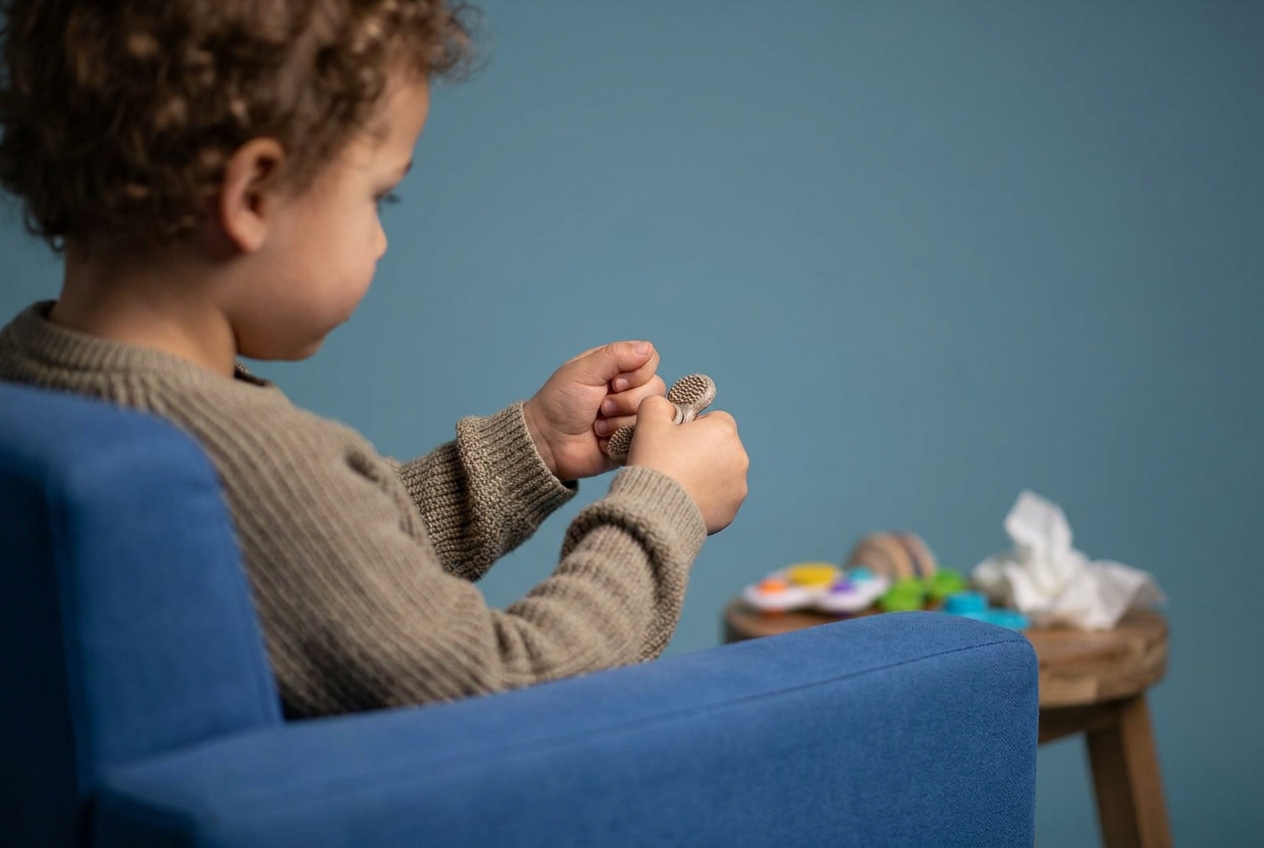
Your child has started asking, every morning, whether you are going to die. Or your child cannot leave the house without three checks that the back door is locked. Or your child has stopped eating lunch at school and is bringing the lunchbox home untouched. Or your child is asking the same question, in the same words, for the seventh time tonight. The school says they don't see anxiety. The GP suggested a parenting group. You can see what you can see. This article will help you name what you are seeing, and ask the right thing of the right professional.
Why anxiety in an autistic child looks different
Because the autistic nervous system processes the world differently, and an anxiety response in that system looks unlike the anxiety response in a neurotypical child.
Around 70% of autistic people meet criteria for at least one coexisting psychiatric condition. Anxiety is the most common. (NICE CG170; AsdHelpingHands review, 2025.)
What this looks like, in real children, is rarely the textbook nervous wringing of hands. It is more often one or more of these:
- Rigid routines. Insistence on sameness. The same cup, the same path home, the same words at bedtime. Disruption to the routine causes disproportionate distress.
- Controlling behaviour. Wanting to know what is happening, who is coming, where you are at every moment. Reading like demand or rudeness; functioning as anxiety.
- Rage and apparent aggression. Fight-or-flight, with fight winning. Often misread as a behavioural problem rather than the anxiety driving it.
- Freezing or shutdown. The opposite. Silent, still, refusing to move, sometimes for hours. Often misread as defiance or sulking.
- Repeated questions. Asking the same thing again and again, often about safety, weather, food, illness. Each answer drops the anxiety for two minutes; then the loop restarts.
- Somatic symptoms. Tummy aches, headaches, feeling sick on school mornings but not at weekends. Often the only sign anyone but you sees.
- Masked at school, collapsed at home. The commonest school-versus-home contradiction. See our piece on after-school restraint collapse.
The four sub-types of autistic anxiety
Most autistic children show one or two of these patterns dominantly. The right support is different for each.
Why standard anxiety advice often misfires
Most anxiety-management advice is designed for neurotypical adult brains. It often makes autistic anxiety worse, not better. Three common pieces of advice that work for neurotypical children and misfire for autistic ones:
- “Just talk to your child about how they feel.” Many autistic children struggle to describe internal states (alexithymia). Direct questioning often produces “I don't know,” not because they are evading but because the words aren't available. Better: side-on, low-pressure, scaffolded with pictures or options.
- “Exposure to the thing they fear builds tolerance.” Sometimes true for neurotypical children with phobic anxiety. Often counterproductive for autistic children, where the anxiety is generated by sensory overload or genuine unmet support needs. Forced exposure shrinks tolerance, not grows it.
- “Don't reassure them, you'll feed the anxiety.” True for some forms of OCD-type anxiety. Not true for autistic predictability anxiety, where consistent, calm answers genuinely lower the load. The therapist who tells you not to answer is sometimes giving you the wrong model.
In autistic children, anxiety is often a sensible response to a genuinely unsuitable environment.
That is the reframe most experienced SEND clinicians use. Treating the child without changing the environment is half the work, and often the easier half. The harder half is reducing the demand and increasing the predictability.
What actually helps (and what the evidence says)
The interventions with the strongest UK evidence base for autistic anxiety, in the order to try them:
- Environmental adjustment. The first move. Sensory accommodations, predictable routines, reasonable adjustments at school under the Equality Act 2010. Often the most powerful single intervention.
- Adapted CBT. Cognitive Behavioural Therapy modified for autistic children: more concrete, more visual, more written-down, less abstract-feelings-talk, more problem-solving-language. NICE CG170 specifically recommends adapted CBT for autistic children with anxiety where they have the verbal and cognitive ability to engage. (NICE CG170, 2021 update, reviewed 2025. See References.)
- Parent-mediated approaches. Programmes that train parents in specific anxiety-reduction techniques tailored for autistic children. The Anna Freud Centre and several NHS paediatric mental health services run these.
- School-based support. ELSA (Emotional Literacy Support Assistants) in many primary schools; sensory circuits; zones-of-regulation-based teaching. Worth requesting through the SENDCO.
- Medication, in some cases. SSRIs (selective serotonin reuptake inhibitors) are prescribed for some children with severe anxiety, usually under specialist CAMHS input and alongside therapy. Not a first move, not a quick fix; useful in the right case.
The NICE CG170 framework in plain English
NICE Clinical Guideline 170 is the document the NHS uses to decide what autistic children with mental health needs should be offered. It was last updated in 2021 and last reviewed in 2025. In plain English, what NICE CG170 says about anxiety:
- Assess for anxiety and other mental-health problems routinely as part of caring for an autistic child. It is common enough that not checking is poor practice.
- Offer adapted CBT (group or individual, depending on the child's preference and ability to engage) as a first-line treatment for anxiety in autistic children who can engage.
- Where CBT is not appropriate (younger child, intellectual disability), use parent-mediated and behavioural approaches instead.
- Consider medication (SSRI) only after psychological interventions, and only with specialist input.
- Treat coexisting conditions (sleep problems, ADHD, challenging behaviour) directly because they amplify anxiety.
You can quote the guideline number to a GP or a CAMHS triage worker, and you should. The right sentence:
“Under NICE CG170, please can we discuss adapted CBT for my autistic child's anxiety.”
(NICE, CG170. See References.)
How to ask the GP for the right thing
The GP is the gateway. Asking for the wrong thing means waiting weeks for the wrong service. A script, adapted to your child: “[Child] is autistic / awaiting assessment and is experiencing significant anxiety. The pattern at home is [repeated questions / school avoidance / rigidity / somatic symptoms]. I'm aware that NICE CG170 recommends adapted CBT for autistic children with anxiety. Please could we discuss a referral to CAMHS or to the local autism support pathway, and what I can do at home in the meantime?”
What you want from the GP, in order: a referral to CAMHS or the local autism mental-health pathway, a Reasonable Adjustment Flag added to your child's record (see our piece on GP, dentist and hairdresser appointments), and a follow-up appointment in six weeks regardless of referral outcome. CAMHS waits in much of the UK are long; don't wait passively.
When it's school anxiety, OCD, or something else
A few patterns sit at the boundary of autistic anxiety and deserve their own naming.
- School-specific anxiety. Increasing tummy aches on school mornings, refusal to leave the house, crying at bedtime on Sundays. This is moving towards Emotionally Based School Avoidance (EBSA). The response is different from general anxiety; act on it early.
- OCD-shaped anxiety. Repeated checking (lights, doors, the cooker), intrusive thoughts (germs, harm), rigid rituals to ward off bad outcomes. Many autistic children have OCD-like patterns; some have genuine OCD. CAMHS specialist input is what tells them apart.
- PDA-profile anxiety. Anxiety expressed as extreme avoidance of demands, even pleasant ones. Looks controlling or rude. The PDA Society describes this as anxiety-driven autonomy-seeking. Different parenting approaches apply.
- Depression in disguise. Lost interests, sleep disturbance, hopelessness, statements about not wanting to be here. Anxiety and depression often co-occur. The second needs urgent attention; see our piece on what to do when an autistic child says “I hate you”.
What to do this week
Three things. Identify the sub-type first: sensory, predictability, social, generalised. Use the table in chapter two and write down which is dominant, because the right adjustments flow from this. Then take the pattern to the GP. Then lower the environment at home; don't wait for CAMHS to do this, it is yours to start.
Where this comes from
The sources behind every claim in this article.
- NICE clinical guideline CG170. NICE, Autism spectrum disorder in under 19s: support and management (CG170). First published 2013, last updated 2021, last reviewed 2025.
- Prevalence of coexisting anxiety. Approximately 70% of autistic people meet criteria for at least one other psychiatric disorder; anxiety is the most common. NICE CG170 recommendations; supporting evidence reviewed by NICE technical team and recent UK epidemiological cohorts.
- DfE evidence review on autistic CYP needs. Department for Education, Identifying and supporting the needs of autistic children and young people: a rapid evidence review (2025).
- Window of tolerance and co-regulation. Beacon House, window of tolerance resources for parents and schools.
- National Autistic Society on anxiety. National Autistic Society, anxiety in autistic children; PDA-profile resources from the PDA Society.
- Mental health support. Anna Freud; YoungMinds (Parents Helpline 0808 802 5544); Papyrus (HOPELINE247 0800 068 4141, under 35s).
If your child is in crisis or talking about not wanting to be here: call the GP today, NHS 111, or in immediate danger 999. Crisis support: Samaritans 116 123; Papyrus HOPELINE247 0800 068 4141 (under 35s); Shout text 85258. YoungMinds Parents Helpline 0808 802 5544.
This article is general information, not a clinical or legal opinion. It has been reviewed by a qualified UK SEND specialist, but does not replace advice from your GP, your child's school, or a qualified mental health professional.
About the reviewer

Emma Owen
Owner of The SEN Support Studio
Former Local Authority SEN Advisor & specialist SEN teacher · 6+ years across SEN
Emma has 6+ years' experience across SEN as a teacher, Local Authority SEN Advisor and Trainer, and specialist SEN teacher. She has supported families through EHCPs, Annual Reviews, and tribunals, as well as sensory deep dives and personalised SEN Support. She works daily with complex needs including Autism, ADHD, SLCN, and sensory differences, and offers clear, practical, and personalised guidance to help parents understand their child and take confident next steps.
Scope of review: Emma reviews Remarkable Minds's content on EHCPs, annual reviews, transitions, sensory support, and parent advisory topics. She does not provide legal advice on tribunal proceedings; for that, contact IPSEA or SOSSEN.
Reviewed by Emma Owen ·