
It is nearly eleven at night and you are searching "why does my child struggle so much with maths". The times tables will not stick, however many evenings you drill them. Homework ends in tears again. Your child still counts on their fingers long after the rest of the class stopped, panics over change in a shop, cannot read a clock. The school keeps saying they just need more practice, or that they will catch up. Part of you suspects this is more than slow progress, and you do not even know whether it has a name. It does.
What dyscalculia actually is, and what it isn't
Dyscalculia is a specific learning difficulty with numbers. The core problem is number sense: understanding what numbers actually mean, comparing quantities, estimating, holding place value, and remembering number facts. It is present from a young age and it persists, even when a child is taught well and tries hard.
Two pieces of UK framing matter more than anything else on this page, because getting them wrong is what keeps families stuck.
First, dyscalculia is a specific learning difficulty (SpLD), in the same family as dyslexia and dyspraxia. It is not a learning disability. A learning disability means a reduced general intellectual ability that affects everyday life across the board. A specific learning difficulty does not. Dyscalculia sits independently of how clever your child is. A bright, articulate child who reads above their age can still be unable to hold a number bond in their head (Mencap, on the difference between a learning disability and a specific learning difficulty).
Second, what it is not. It is not laziness. It is not low ability. It is not bad teaching at home or at school. And it is not the same thing as maths anxiety, although the two so often travel together that they get muddled. Devine and colleagues, working with English children in 2018, found that dyscalculia and maths anxiety "largely dissociate". In plain terms, you can have one without the other, and they need different help (Devine et al., 2018, Journal of Educational Psychology).
Dyscalculia or maths anxiety?
Because the two get confused so easily, this is the comparison worth keeping in your head. Most children who are really struggling have a bit of both, but one usually leads.
There is one more distinction worth knowing, because it is brand new and it may explain your child even if the word "dyscalculia" never quite fits. In March 2025, the body that sets assessment standards in this field (SASC, the SpLD Assessment Standards Committee) published a fresh definition. It splits the narrow term dyscalculia, meaning a core difficulty with numerical magnitude, from a wider category it calls a specific learning difficulty in mathematics. The wider one is driven by other things: weak working memory, language processing, or visual-spatial difficulties getting in the way of maths. The practical upshot for you is reassuring. Your child can have a real, recognised difficulty with maths, and deserve real support, even if a tight dyscalculia label does not land exactly (SASC, 2025; British Dyslexia Association, 2025).
For a closer look at the term and how a diagnosis works, see what dyscalculia is and how it is diagnosed.
What it looks like at home and at school
It changes with age, so here is the picture by stage. You will not see all of these, and one or two on their own prove nothing. It is the pattern, holding steady over months despite effort, that matters.
In the early years and Reception to Year 2
- Struggles to learn to count, or to count a set of objects accurately, skipping some or counting one twice.
- Cannot reliably connect the written numeral "5" to five things.
- Finds it hard to say which of two numbers is bigger.
- Cannot recognise small amounts (three sweets, four dots) without counting them one by one. Specialists call this subitising, and most children pick it up early.
Through primary school
- Still counting on fingers or in ones long after classmates moved on.
- Cannot recall number bonds or times tables, however much they are drilled.
- Loses track halfway through a calculation, or cannot spot an answer that is obviously wrong (says 4 plus 5 is 30 and does not blink).
- Reverses or confuses digits, and finds place value (tens, hundreds, thousands) genuinely baffling.
The things that worry you at home
These are usually what tip a parent into searching at night. Your child cannot tell the time on an analogue clock, or judge how long ten minutes is. They get lost with money and change. They mix up left and right, and the order of things. And there is the emotional layer that hurts the most: disproportionate distress before maths, stomachaches on test days, the flat statement that they are "stupid". That self-talk is the part to take seriously fastest, because a child who decides they cannot do maths will stop trying, and then everyone mistakes the giving-up for the cause.
Schools will often say "they just need more practice" or "they will catch up". What that misses is the thing that makes dyscalculia dyscalculia: more of the same practice is exactly what does not work for a number-sense difficulty. The answer is not more. It is different.
Drilling times tables harder into a child who has no secure sense of what the numbers mean is like turning up the volume for someone who needs the words explained.
Why dyscalculia gets missed
Here is the fact that reframes everything, and that almost no listicle leads with: dyscalculia is roughly as common as dyslexia, yet it is hardly ever formally identified. In the Morsanyi study of 2,421 primary-age children in Northern Ireland, about 6% had a persistent, severe maths difficulty. The number of those children with an actual dyscalculia diagnosis was one. In the same group, 108 children had a dyslexia diagnosis. That is roughly a hundredfold gap for conditions of similar prevalence (Morsanyi et al., 2018, British Journal of Psychology).
Why the gap? A few reasons stack up.
- Far less public and teacher awareness. Most parents have heard of dyslexia; few have heard of dyscalculia.
- Far fewer trained assessors who can identify it.
- A cultural shrug that lets it slide. We accept "I was never any good at maths" in a way we would never accept "I was never any good at reading".
- No clinical or NHS route that flags it the way reading difficulties get flagged at school.
The cost lands on your child. Years of being told to practise more. Confidence draining away. A child quietly concluding they are stupid, when the real issue is an unrecognised, lifelong specific learning difficulty. The British Psychological Society, reporting the Morsanyi findings, put it bluntly: children with maths difficulties are far less likely than their dyslexic peers to get an official diagnosis or support (British Psychological Society Research Digest, 2018).
Naming what is happening changes the whole strategy. It moves the question from "how do I make my child try harder" to "how does my child need to be taught". That shift is the single most useful thing in this article, and you do not need a piece of paper from an assessor to make it.
How to get an assessment in the UK
Start with the school, not a clinic. Talk to the class teacher and the SENDCO, the member of staff in charge of special educational needs. New SENDCOs have to hold, or be working towards, the NPQ SENCO qualification, which became the mandatory route from 1 September 2024 (the older NASENCO award is the legacy qualification, still respected). Ask two things: what has already been tried, and whether they are using the graduated approach, the assess, plan, do, review cycle the SEND Code expects.
Now the fact most pages leave out, the one that saves you weeks of phone calls: there is no NHS diagnostic pathway for dyscalculia. It is not assessed by CAMHS or by a paediatrician. The Right to Choose route that families use to speed up autism and ADHD assessments does not apply here at all.
So who can formally assess it? In practice, two kinds of professional:
- An educational psychologist registered with the HCPC (the Health and Care Professions Council). A school can sometimes commission one; otherwise families go private.
- A suitably qualified specialist teacher or assessor, for example one holding an Assessment Practising Certificate with specific dyscalculia training.
A reality check on cost and supply. Private diagnostic assessments commonly run to several hundred pounds, often in the region of £500 to £700 as of 2025, and assessors with genuine dyscalculia expertise are still scarce. Treat that figure as indicative and likely to drift; ring two or three assessors before you commit (Bupa UK, 2024; Contact, 2024; figures current to 2025).
Be clear-eyed about what a diagnosis does and does not buy you. It does not automatically trigger funding or an EHCP. What it does is clarify your child's needs and strengthen the case for the right teaching and reasonable adjustments. And here is the part worth underlining: a school can identify and support need at SEN Support without any formal diagnosis at all. If money is tight, that is your route. See how SEN Support works and how assessment works for the related condition, dyslexia.
Your child's rights and what the school must do
The strongest thing to understand is that the law works off your child's needs, not off a label. You do not have to hand the school a diagnosis to trigger their duties.
Reasonable adjustments. Schools have to make reasonable adjustments for disabled children so they are not put at a substantial disadvantage. A persistent specific learning difficulty like dyscalculia can meet the Equality Act's definition of disability, an impairment with a substantial and long-term effect on everyday activities. The duty follows from the need, not from a certificate (Equality Act 2010, s.20 and s.6). If you want the definition in plain terms, see what counts as a disability under the Equality Act 2010.
The graduated approach. In the SEND Code of Practice, maths difficulties sit under "cognition and learning", the same group as dyslexia. Before anyone talks about a statutory plan, the school is expected to cycle through assess, plan, do, review at SEN Support, trying things and checking what works (SEND Code of Practice 2015, paras 6.44 to 6.56). There is more on how that cycle runs in the graduated approach explained.
EHCPs. An Education, Health and Care Plan, the legally binding plan the council writes and funds, is for the small minority of children with the most significant and complex needs. Dyscalculia on its own rarely meets that threshold; most children are well supported at SEN Support (Children and Families Act 2014, s.36). The difference between the two is set out in SEN Support versus an EHCP.
Where the law is heading, and what stands today. As of June 2026, two reform proposals are live: the Schools White Paper Every child achieving and thriving (February 2026) and the Education for All Bill (May 2026). Between them they propose a new statutory Individual Support Plan and a narrowing of EHCPs towards the most complex needs by 2035, and a 12-week consultation ran and closed on 18 May 2026. Two things are worth holding steady on. No changes to EHCPs take effect before September 2030, and current EHCP holders are protected. For dyscalculia families, who mostly sit at SEN Support, the proposed statutory Individual Support Plan is the part to watch, not the EHCP changes. Everything in this section is current law; the rest is direction of travel, not yet settled.
If you hit a wall, two free routes exist. Every council has to fund a SENDIASS service, which gives free, impartial advice to parents. And IPSEA offers legal advice on SEND. You can ask the school for its written record of the graduated approach at any time, and you are entitled to it.
What actually helps
The headline, from the Education Endowment Foundation's evidence on maths and on SEN in mainstream schools, is simple: structured, targeted, explicit teaching beats more of the same whole-class practice for children who are stuck (EEF guidance reports, 2021). Here is what that looks like in practice.
Teach number sense, not just procedures. The approach that works moves from concrete to pictorial to abstract: real objects first, then pictures, then symbols. Physical equipment (counters, Numicon, base-ten blocks, number lines) should stay available far longer than for other children. Normalise it. The instinct to whip the equipment away early, so a child "learns to do it in their head", is the opposite of what helps here.
Take the load off working memory. Give your child a times-tables grid and a number line to use as tools, not as something to feel ashamed of. Break multi-step problems into single steps. Allow more time. Cut down on copying from the board, which eats the very memory they need for the maths.
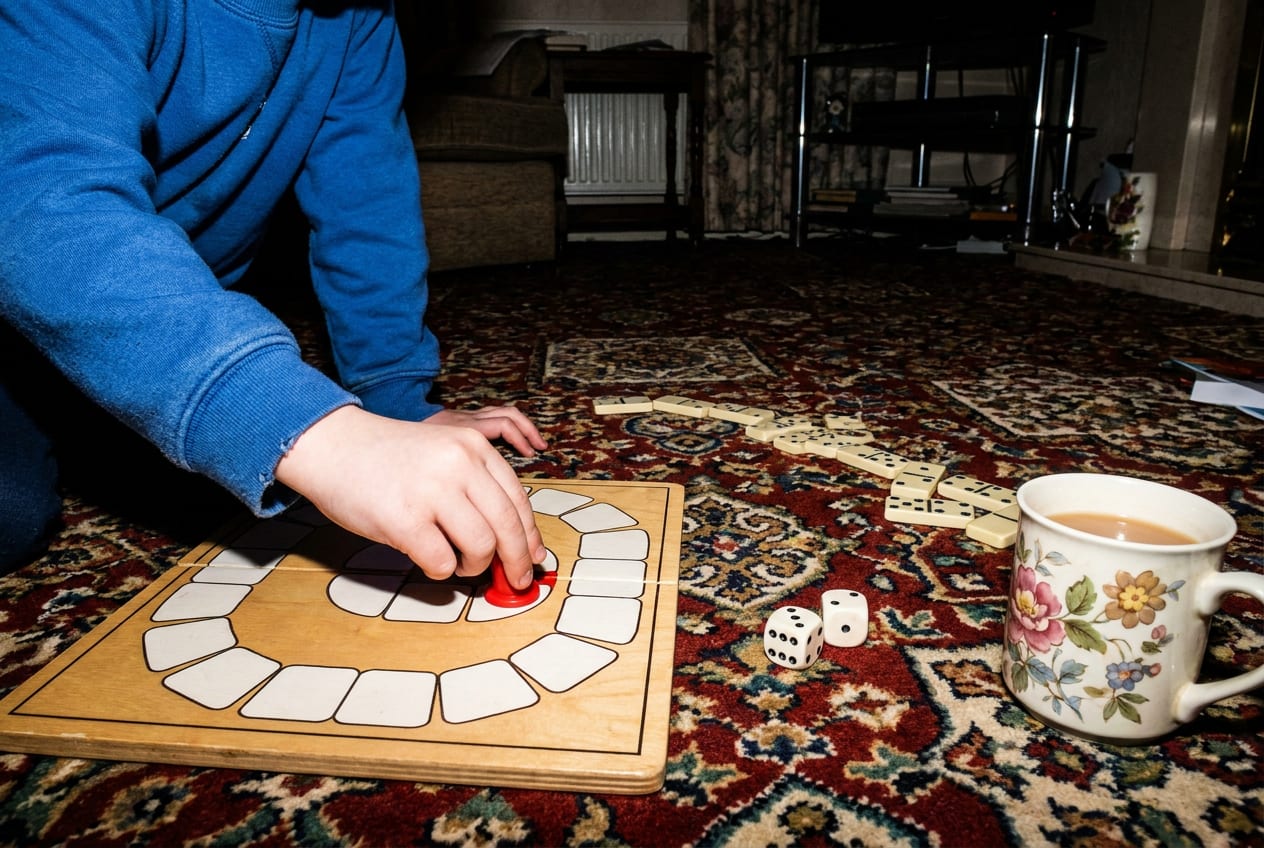
Little and often, low stress. Short, frequent, calm practice beats long anxious sessions. Games carry a lot of this: dice, dominoes, card games, board games with a track to count along all quietly build a sense of how big numbers are. At home, fold maths into real life. Counting out change, weighing ingredients, timing how long until tea. Real money and real cooking do more than a worksheet.
Treat the anxiety separately where it is there. If your child dreads maths, reduce timed-test pressure, praise the effort and the strategy rather than the right answer, and protect, fiercely, their belief that they can learn maths. A child who still thinks they can get better will keep going. That belief is worth more than any single technique.
There is plenty more you can do at the kitchen table. See how to help your child with dyscalculia at home.
What to do this week
If you do nothing else, do these four things.
- Email the SENDCO and ask for a meeting. Say you are worried about your child's maths, that you think it may be more than slow progress, and ask what has been tried and what the graduated-approach plan is. Ask for it in writing.
- Start a one-page record. Note the specific things you see: finger-counting, tables that will not stick, tears over homework, the stomachaches, the "I'm stupid". Dates and examples. This is the evidence that turns "he'll catch up" into a real conversation.
- Ask for support now, not after a diagnosis. The school can act at SEN Support today. Ask specifically for equipment kept available, more time, and structured number-sense teaching rather than more drilling.
- Get free advice if you need it. Your local SENDIASS gives free, impartial help, and IPSEA can advise on the law. Use them before you spend money on a private assessment, not after.
Tonight, the one thing to hold onto is this. Your child is not stupid and they are not lazy. There is a name for what you have been watching, it is more common than almost anyone tells you, and the strategy that helps is teaching maths differently, not making them do more of what already is not working.
This article is general information, not a clinical or legal opinion. It has been reviewed by a qualified UK SEND specialist, but it does not replace advice from your child's school, an educational psychologist, or a qualified solicitor on your specific case.
Where this comes from
The sources behind every claim above. If you are building a case for your child or asking the school for specific support, these are the documents to cite.
- The 2025 definition
- SpLD Assessment Standards Committee, Guidance on the assessment of maths difficulties and dyscalculia (March 2025); British Dyslexia Association, dyscalculia.
- Prevalence and the diagnosis gap
- Morsanyi, van Bers, McCormack & McGourty, "The prevalence of specific learning disorder in mathematics", British Journal of Psychology 109(4), 2018; reported by the British Psychological Society Research Digest.
- Dyscalculia and maths anxiety
- Devine, Soltesz, Nobes, Goswami & Szucs, "Cognitive and emotional math problems largely dissociate", Journal of Educational Psychology 110(3), 2018.
- SpLD versus learning disability
- Mencap, what a learning disability is.
- Assessment routes and cost
- Contact, dyscalculia; Bupa UK, dyscalculia.
- The law
- Equality Act 2010, s.20 (reasonable adjustments) and s.6 (definition of disability); SEND Code of Practice 2015 (paras 6.44 to 6.56); Children and Families Act 2014, s.36.
- What helps: the evidence
- Education Endowment Foundation, SEN in mainstream schools and improving maths; National Numeracy, on spotting and supporting dyscalculia.
- Policy and direction of travel
- House of Lords Library, dyscalculia briefing (2025); POST, dyscalculia: scientific evidence and policy implications. Reform proposals: Schools White Paper Every child achieving and thriving (February 2026) and the Education for All Bill (May 2026).
About the reviewer

Emma Owen
Owner of The SEN Support Studio
Former Local Authority SEN Advisor & specialist SEN teacher · 6+ years across SEN
Emma has 6+ years' experience across SEN as a teacher, Local Authority SEN Advisor and Trainer, and specialist SEN teacher. She has supported families through EHCPs, Annual Reviews, and tribunals, as well as sensory deep dives and personalised SEN Support. She works daily with complex needs including Autism, ADHD, SLCN, and sensory differences, and offers clear, practical, and personalised guidance to help parents understand their child and take confident next steps.
Scope of review: Emma reviews Remarkable Minds's content on EHCPs, annual reviews, transitions, sensory support, and parent advisory topics. She does not provide legal advice on tribunal proceedings; for that, contact IPSEA or SOSSEN.
Reviewed by Emma Owen ·