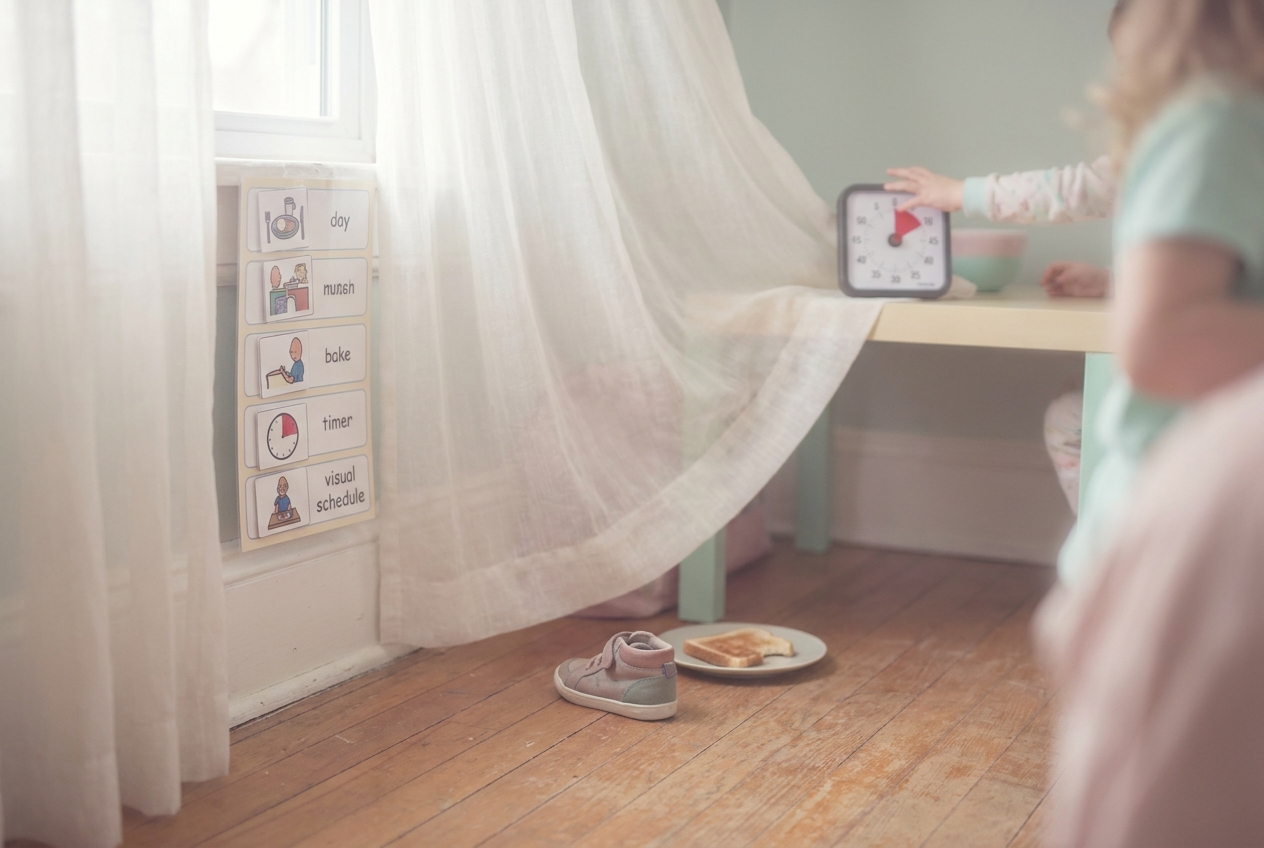
It is 7:50am. Your child is still in pyjamas. The cereal bowl is on the table with two bites missing. The school shoes are somewhere in the lounge. You can hear the older one shouting up the stairs. You have already asked nine times. The car needs to be on the drive in twelve minutes and your child has just locked themselves in the bathroom because the new socks are “wrong.” This is the third morning in a row this week.
Your husband, your mum, the parenting blog you read at 11pm: all of them said the same thing, they just need a firmer routine. Here is what is actually happening, what to change tonight, and what you are owed at school.
Why does my child fall apart every morning?
Because the school morning is the densest block of transitions in a SEND child's week, and every transition costs them regulation. The meltdown is what happens when they run out before the bell goes.
For most neurotypical children, getting out of the house is a sequence: wake, dress, eat, brush, shoes, bag, car. For an autistic or ADHD child it is a series of switches between very different nervous-system states. Sleep is one state. Cold floor on bare feet is another. A bright kitchen with the radio on is a third. The shift from one to the next is what tips them out of regulation, long before they reach the front door.
The 2024 NHS Leicestershire Partnership autism guidance puts this in plain words: meltdowns happen when an autistic person becomes completely overwhelmed by their current situation and temporarily loses behavioural control. The trigger looks small to you (the sock, the cup, the missing book). The cause is the four transitions that already happened that morning. (Leicestershire Partnership NHS Trust, Autism Space. See References.)
For an ADHD child the shape is slightly different but the result is the same. Attentional control is harder; switching off a high-interest task (the iPad, the Lego project they fell asleep next to) and on to a low-interest one (teeth, shoes) takes far more effort than it does for other children. The ADHD Foundation calls this the “task initiation” problem; from the outside it looks like deliberate refusal. (ADHD Foundation. See References.)
What is actually happening in their nervous system
The nervous system is moving up and down between three states before 8am. By the time the meltdown happens it has been pushed past where they can recover from on their own.
The model most UK SENDCOs use to talk about this with parents is Dan Siegel's window of tolerance, popularised for British schools by Beacon House (a trauma-informed therapy team in Sussex). Inside the window, a child can think, listen, follow a two-step instruction, and tolerate the small irritations of getting dressed. Above the window, they are in fight-or-flight: shouting, hitting, running upstairs, slamming doors. Below the window, they are in shutdown: silent, frozen, refusing to move, curled under a duvet.
For a SEND child, the window is narrower to begin with and the morning eats into it faster. By 7:55am, what looks like wilful refusal is usually a child who has tipped out of the window and cannot get back in without your help. Telling them to hurry up, counting to three, or threatening loss of screen time all do the same thing: they push the child further out of the window, not back in.
The thing parents most often misread is the sock complaint. By the time a child is in the bathroom shouting that the seam is wrong, they have used up the last of their regulation on the four transitions before it. Fixing the sock will not fix the morning. Lowering the load on the four transitions before it will.
The sock is rarely about the sock. It is the place the system finally cracks.
The seven points where a SEND morning breaks
Almost every morning meltdown happens at one of these seven points. Naming them lets you redesign the morning around them.
You do not have to fix all seven. Pick the two where your child most often comes off the rails and start there. Most families see the worst of the morning ease inside a fortnight if they pick the right two.
What helps in the 60 minutes before school
Three things, in this order. None of them are new, but most households are doing one of the three, not all three.
One: a visual schedule, on the wall. Not a list you read out. A drawing or a photo strip showing the steps from waking to leaving. Print it, laminate it if you can, and put it where your child eats breakfast. The point is that you stop being the one giving the instructions; the chart is. For an autistic or ADHD child this single shift, from your voice to a picture, is often the biggest change you can make to the whole morning. The Organisation for Autism Research found visual schedules improved task engagement and independence across multiple settings. (OAR, summarised in Pediatric Consultations briefing. See References.)
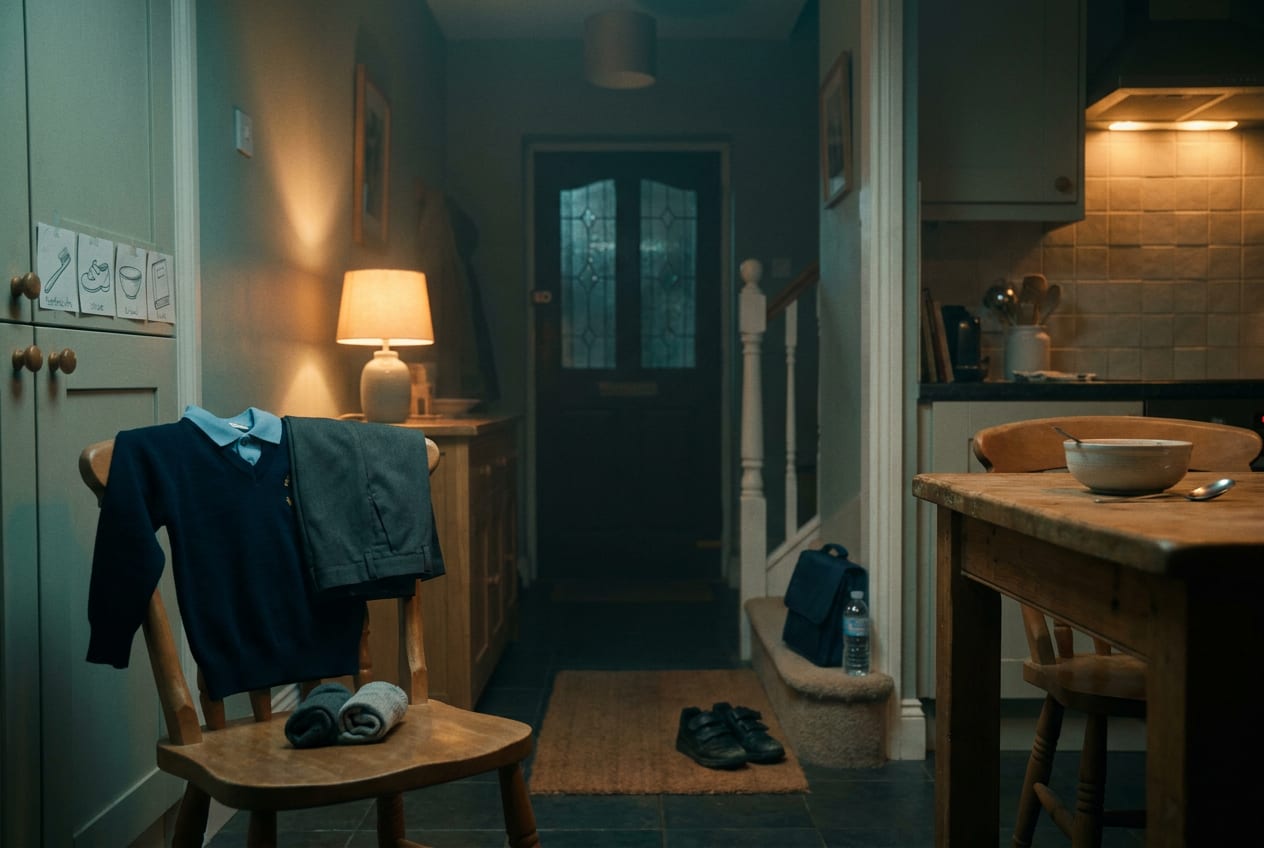
Two: prep the night before. Uniform out, shoes by the door, bag packed, water bottle filled, the bowl on the table. Every choice you remove from the morning is a choice the child does not have to make through a narrow window. Aim for zero decisions to be made between 7am and 8:30am.
Three: a soft start. Wake your child fifteen minutes earlier than you think you need to and let the first fifteen minutes be quiet. No questions. No instructions. A warm drink, the same TV programme, a hand on the back. The morning that starts well almost always ends in shoes on time. The morning that starts with rushed voices almost never does.
One sentence parents tell me makes the biggest difference is said out loud at 6:55am, to yourself: “The next forty minutes will run faster if I move slower.” Slower voice, slower instructions, fewer of them. Children who are out of their window cannot speed up because you do. They can only mirror you.
What makes the morning worse
Almost everything most parenting advice tells you to do. That is the hard bit to swallow. The patterns that reliably break a SEND morning:
- Counting to three. Useful for a regulated three-year-old. For an autistic eight-year-old already past their window, it adds a time threat to an overflowing system.
- Removing screens as a sanction. The thing they were watching may have been the one regulator they had.
- Bargaining with rewards. “If you get your shoes on now, you can have an ice lolly after school.” Future rewards do not help a child whose nervous system is currently dysregulated. They confuse the moment further.
- Asking why. “Why won't you put your shoes on?” They cannot answer. The answer would require the very executive function that has just collapsed.
- The audience. An older sibling watching from the top of the stairs. A second parent stepping in to tell them off. More adult voices, more eyes, less regulation.
- Same-day pressure (today there is a school trip, today is the spelling test, today the SENDCO is doing observation). If you know it is going to be a hard day, the morning has to be lighter, not heavier.
What to ask the school for
The morning meltdown does not stop at the school gate. If your child arrives in distress, the first thirty minutes of class are lost. The adjustments that help live inside the school day.
Under the Equality Act 2010, schools owe disabled children reasonable adjustments. (Equality Act 2010, section 20. See References.) The SEND Code of Practice 2015 chapter 6 adds the graduated approach: assess, plan, do, review. (SEND Code of Practice 2015, paragraphs 6.36 and 6.44 to 6.56.)
The Act treats this as an anticipatory duty. School has to think ahead about what a disabled child will need, not wait for a crisis.
The adjustments worth asking for, in plain words:
- A soft drop-off. Arriving five minutes before or after the playground bell. Coming in through a side door. A named adult to meet your child at that door, not in the corridor.
- A regulation slot before the first lesson. Ten minutes in the library, with a fidget or a book, before maths starts. Not a sanction; a soft landing.
- A home-school communication that does not depend on your child remembering anything. A short email or a shared sheet, not a book in the bottom of a school bag.
- A reduced or modified homework load. If the bedtime that feeds into the morning is being eaten by homework battles, the morning will never get easier. This is a negotiation, but a reasonable one.
- A late-start or staggered timetable on the days after particularly hard nights, if absence is otherwise creeping in.
When this is school avoidance, not just a hard morning
A fortnight of difficult mornings is one thing. Four weeks, with the child refusing to leave the house, is the start of something you should not handle alone.
The pattern to watch for is emotionally based school avoidance (EBSA): a child whose anxiety about school has reached the point where they cannot make it through the door. The wording still varies from school to school, and it is worth knowing which one you are hearing.
Signs the picture is escalating:
- The meltdowns are starting earlier (the night before, on a Sunday afternoon, on the way out of the bedroom).
- Your child is complaining of tummy aches, headaches, feeling sick on school mornings but not at weekends.
- You are having to physically get them into the car.
- School attendance is starting to slip, even half-days.
- Your child has said, in any wording, that they do not want to be here.
If two or three of those are true, the next steps are not another tweak to the morning. They are a SENDCO meeting, a GP appointment, and a careful read of our piece on EBSA.
What to do this week
Three things, in order. None of them require permission.
This article is general information, not a clinical or legal opinion. It has been reviewed by a qualified UK SEND specialist, but it doesn't replace advice from your GP, your child's school, or a qualified solicitor about your specific case.
For free, regulated SEND advice on adjustments and conversations with school: IPSEA, Contact (parent helpline 0808 808 3555), Council for Disabled Children, or your local SENDIASS (one per council area, free and confidential).
If your child is talking about not wanting to be here, call your GP today and ask for an urgent appointment. Out of hours: 999, or NHS 111. Crisis support: Samaritans 116 123; Papyrus HOPELINE247 0800 068 4141 (under 35s); Shout text 85258. YoungMinds Parents Helpline 0808 802 5544.
Where this comes from
The sources behind every claim in this article.
- The window-of-tolerance model. Dan Siegel, The Developing Mind (Guilford Press, 1999). UK clinical adaptation and parent-facing resources from Beacon House Therapeutic Services (Sussex).
- Meltdowns, shutdowns and autistic regulation. Leicestershire Partnership NHS Trust, Autism Space. NHS-published guidance for parents on what meltdowns are and what helps.
- NHS autism behaviour advice. NHS, How to help with your autistic child's behaviour.
- ADHD, task initiation and transitions. ADHD Foundation, the UK's largest ADHD charity, on emotional regulation and executive function.
- Visual schedules and routine evidence. Organisation for Autism Research, summarised parent-facing briefings on visual schedules and task engagement. See also National Autistic Society, visual supports.
- Reasonable adjustments duty on schools. Section 20, Equality Act 2010. Schedule 13 sets out how the duty applies to schools. EHRC technical guidance on reasonable adjustments for disabled pupils.
- The graduated approach in mainstream schools. SEND Code of Practice 2015, paragraphs 6.36 and 6.44 to 6.56.
- EBSA framework reference. West Sussex Educational Psychology Service, Emotionally Based School Avoidance guidance for schools and families (the source UK SENDCOs most often cite when reframing “school refusal”).
About the reviewer

Emma Owen
Owner of The SEN Support Studio
Former Local Authority SEN Advisor & specialist SEN teacher · 6+ years across SEN
Emma has 6+ years' experience across SEN as a teacher, Local Authority SEN Advisor and Trainer, and specialist SEN teacher. She has supported families through EHCPs, Annual Reviews, and tribunals, as well as sensory deep dives and personalised SEN Support. She works daily with complex needs including Autism, ADHD, SLCN, and sensory differences, and offers clear, practical, and personalised guidance to help parents understand their child and take confident next steps.
Scope of review: Emma reviews Remarkable Minds's content on EHCPs, annual reviews, transitions, sensory support, and parent advisory topics. She does not provide legal advice on tribunal proceedings; for that, contact IPSEA or SOSSEN.
Reviewed by Emma Owen ·