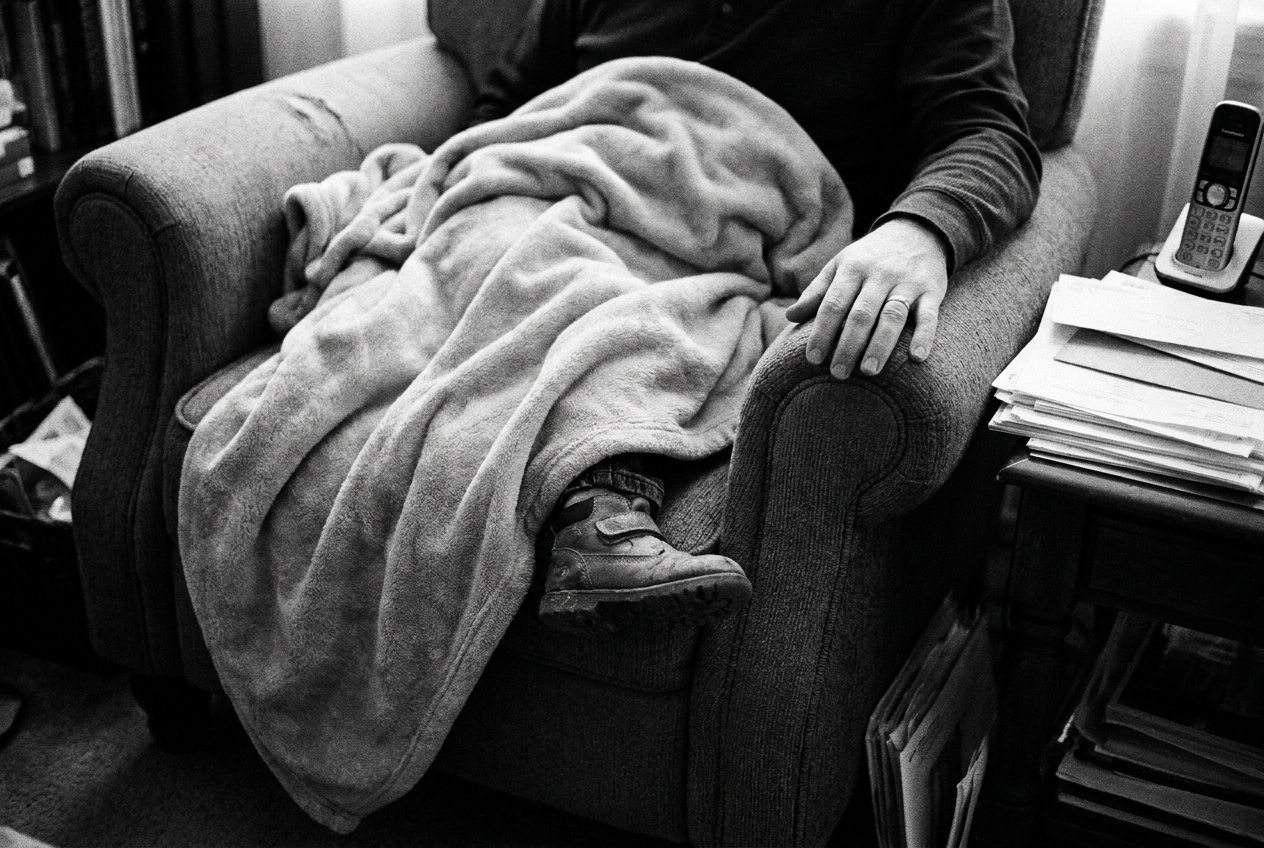
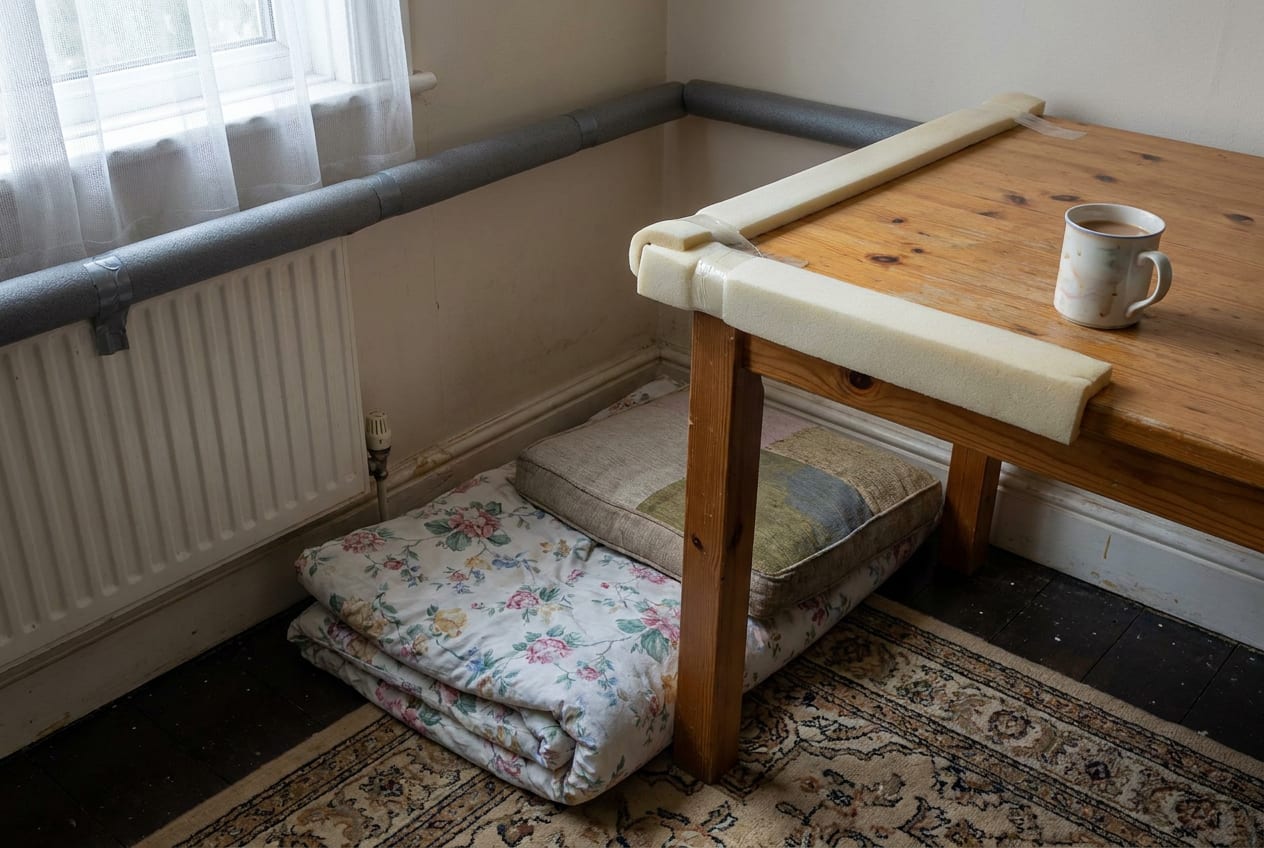
Your three-year-old has started banging her head against the wall when she is upset. You have read the worst-case versions and not slept. Your mother told you on the phone yesterday that her brother used to do it and grew out of it; that did not help. The GP said to make a referral but the wait is six months. You are watching for it constantly and have padded the corner of the dining room.
This article is what self-injury actually is in young children, what to do first, and the UK route to specialist help that genuinely works.
What self-injurious behaviour actually is
Self-injurious behaviour (SIB) describes repetitive, deliberate-looking behaviours that cause physical injury or have the potential to. It is a specific clinical descriptor, not just hurting oneself, and the framing matters. The commonest forms in young autistic and intellectually disabled children:
- Head-banging, on walls, floors or furniture.
- Hitting oneself with hands or objects.
- Biting fingers, hands, arms.
- Hair-pulling, in a trichotillomania pattern.
- Skin-picking, scratching, gouging.
- Eye-poking or eye-pressing.
- Repeated digit-sucking or mouthing that causes injury.
The autism-related framing differs significantly from the adolescent-mental-health framing of self-harm, and the two lead to opposite first responses.
How common it is, and why this matters
More common than parents are usually told, and less common as the child grows. Cerebra and the Challenging Behaviour Foundation summarise the prevalence data.
Age matters as much as the headline percentages.
- Onset can be as early as 12 months. Most childhood SIB emerges between 2 and 5 years.
- For most children, frequency and severity reduce by adolescence. For a minority, particularly those with specific syndromes or severe learning disability, SIB persists into adulthood.
The reason the numbers matter: SIB is much more common than the general practitioner sees in their training, and many first-line responses (“just ignore it”, “put a helmet on her”) reflect that. Knowing it is common gives you ground to insist on specialist input.
The PEACE framework: read the cause first
Cerebra's evidence-based starting point. Five things to consider before trying an intervention, in this order.
PEACE is deliberately ordered. Pain first. For some children, treating the toothache or the reflux ends the SIB without any further intervention. (Cerebra PEACE framework, 2019)
The functions self-injury can serve
Functional analysis identifies what the behaviour is doing for the child. The behaviour is doing a job, and the job is what to address.
- Pain signalling. The child is in pain and the SIB is communicating it, or seeking counter-stimulation that masks it. Always check first.
- Sensory regulation. The repetitive input provides regulatory feedback the child cannot otherwise access. Common with non-speaking autistic children.
- Communication. “I'm overwhelmed.” “I want this thing.” “Stop.” Particularly where speech and alternative communication are not available.
- Escape from demand. If SIB consistently ends a demand, the child has learned, without trying, that SIB makes the demand go away.
- Attention. Less commonly the primary function in clinical samples, but real in some cases. The right response is rich communication and connection outside the SIB, not removal of attention during SIB, which can itself be unsafe.
- Stereotypy. Some repetitive movements that started for one reason become habitual self-stimulatory patterns. Often the SIB at this stage looks different from where it started.
The functional analysis is not a parent-side task. A clinical psychologist, behaviour specialist, or specialist paediatrician with autism or learning-disability experience leads it. They observe, gather context, and propose function-specific interventions.
What to do in the moment
Three priorities. The clinical work happens between episodes, not during them.
- Protect. Pad nearby surfaces. Move the child to a softer area if possible. Insert your hand between the child and the hard surface if needed. Do not restrain unless safety requires it.
- Stay calm and quiet. Lower your voice. Slow your breath. The child's nervous system mirrors yours, and the loud distressed adult is the wrong input.
- Wait the episode through and observe. Note what preceded it, what continued through it, what ended it. The observation pattern over time is what specialists use to identify function.
One thing many parents instinctively try, and most specialists advise against: rewarding stopping. The chain you teach is “SIB starts → reward arrives.” The behaviour grows. The right response is to remove the triggers when possible, give your child alternative ways to communicate or regulate when not in crisis, and keep the in-moment response calm and brief.
What makes self-injury worse
Several common adult responses backfire.
- Big visible emotional reactions. Tears, panic, raised voice. The child learns the behaviour produces a big response.
- Helmets and arm splints without expert input. Sometimes appropriate, but only after functional analysis and risk assessment. Used reflexively, they can reinforce the behaviour or shift it elsewhere.
- Routine restraint. Holding a child to stop SIB triggers fight response and escalates many episodes. Restraint is sometimes necessary as a last-resort safety measure but should not be a daily strategy.
- Ignoring extensively. Sometimes advised for attention-seeking behaviour. Almost always inappropriate for SIB, which is rarely simply attention-seeking and is by definition causing injury.
- Time-outs and punishment. Inappropriate for distress-driven behaviour. Damages trust and does not address function.
Specialist help: what works
SIB is a clinical-grade problem. Specialist input changes the trajectory.
- GP or community paediatrician. First step. Rule out pain. Bloods if anaemia or thyroid is possible.
- Dental review if the child is non-speaking. Dental pain is one of the most missed causes.
- Specialist behaviour team or LD-specialist CAMHS. Functional behaviour assessment. A plan with specific, function-matched interventions.
- Sensory OT. Where sensory regulation is part of the function, an OT-led sensory plan often reduces SIB substantially.
- SaLT. Augmentative and alternative communication (AAC), such as PECS, signing, or devices, gives non-speaking children a route to communicate that does not need SIB.
- Positive Behaviour Support (PBS) services. Many local authorities commission PBS for children with learning disability. The approach is function-led and family-supportive.
- Specialist charities. Cerebra (learning disability focus), the Challenging Behaviour Foundation, and the National Autistic Society. All publish evidence-based guidance and offer support lines.
When this is a medical emergency
Some presentations need immediate medical attention.
Mental health crisis support also applies: YoungMinds Parents Helpline 0808 802 5544; Samaritans 116 123; Papyrus HOPELINE247 0800 068 4141 (under 35s).
What to do this week
Three things, and none of them need the six-month referral wait to be over first. Start with pain, because it is the most missed cause and the one you can act on now.
If you want someone to sit with you in this, a Remarkable Minds SEND specialist will help you walk through PEACE, plan the GP conversation, and identify what specialist input to push for. £60 for a 45-minute video call. Find a specialist.
Where this comes from
The sources behind every claim in this article.
- Cerebra evidence-based guidance. Cerebra, Self-injury in children with intellectual disability, including the PEACE framework. The most thorough UK parent-facing briefing.
- NAS guidance. National Autistic Society, Self-injurious behaviour.
- Challenging Behaviour Foundation. Challenging Behaviour Foundation, 0300 666 0126. UK lead organisation for severe learning disability and challenging behaviour.
- UK research and academic groups. The Cerebra Network for Neurodevelopmental Disorders at the University of Birmingham; the IASSIDD and ALD research communities; Oliver, Petty & Arron on SIB and intellectual disability.
- Positive Behaviour Support. BILD, the British Institute of Learning Disabilities, PBS resources; and the UK PBS Coalition.
If your child has had a head injury or is at risk: 999 or A&E. NHS 111 for non-acute concerns. Mental health support: YoungMinds Parents Helpline 0808 802 5544; Samaritans 116 123; Papyrus HOPELINE247 0800 068 4141.
Content note: this article discusses self-injurious behaviour in autistic and intellectually disabled children. It is general information, not clinical advice. Self-injury that is causing significant harm needs specialist medical input.
About the reviewer

Emma Owen
Owner of The SEN Support Studio
Former Local Authority SEN Advisor & specialist SEN teacher · 6+ years across SEN
Emma has 6+ years' experience across SEN as a teacher, Local Authority SEN Advisor and Trainer, and specialist SEN teacher. She has supported families through EHCPs, Annual Reviews, and tribunals, as well as sensory deep dives and personalised SEN Support. She works daily with complex needs including Autism, ADHD, SLCN, and sensory differences, and offers clear, practical, and personalised guidance to help parents understand their child and take confident next steps.
Scope of review: Emma reviews Remarkable Minds's content on EHCPs, annual reviews, transitions, sensory support, and parent advisory topics. She does not provide legal advice on tribunal proceedings; for that, contact IPSEA or SOSSEN.
Reviewed by Emma Owen ·