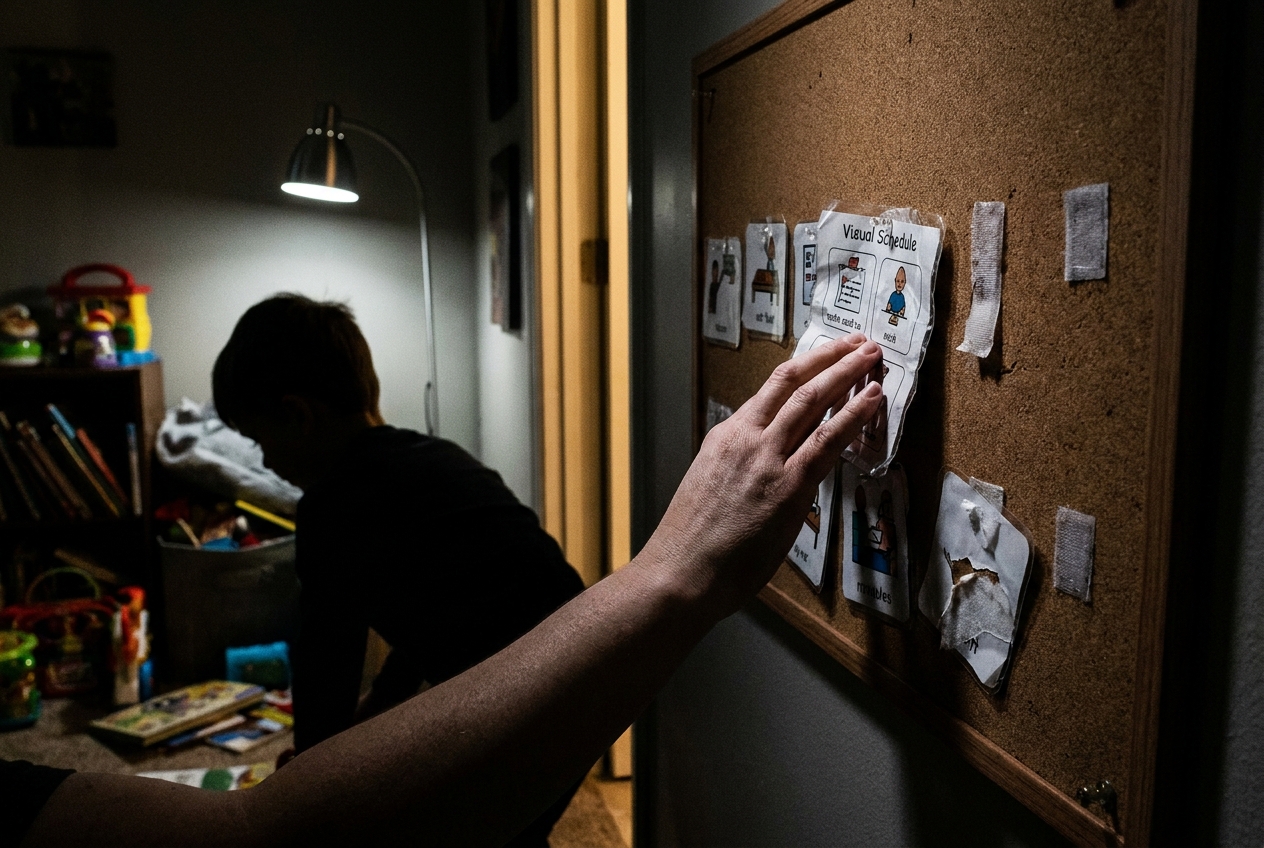
You built the morning schedule three months ago. You laminated. You printed velcro dots. Your child looked at it twice and you cried with relief. For about six weeks it worked.
Now it is ignored. The pictures are peeling off. The wake-up, teeth, dressed, breakfast, shoes routine comes apart at exactly the same place every morning, between getting dressed and going to breakfast. The Internet has told you to be patient and to try harder. The Internet is wrong. There is a specific reason your schedule is not working, and a specific fix.
Why visual schedules work in the first place
The mechanism matters. Knowing why they help is what lets you read them when they are not helping. Visual schedules work by:
- Externalising the routine so your child does not have to hold the sequence in working memory.
- Replacing your voice with a non-pressuring cue. The chart says it, not you.
- Providing predictability through a visible end-point.
- Making transitions visible: “next we do this.”
- Reducing demand overall. Your child can check the schedule on their own terms.
When a schedule stops working, one of those mechanisms has broken. Identifying which one is the diagnostic question.
The eight reasons schedules stop working
These are specific, fixable problems, and yours is almost always on this list.
The two-week audit before redesigning
Resist the urge to rebuild before you observe. Two weeks of data tells you which fix is yours. Track three signals daily:
- Independence rate. Did your child move to the next step without a prompt? Yes or no for each step.
- Transition latency. How many seconds between the cue, visual or verbal, and your child starting? Ten seconds is fine. Ninety seconds is a different problem from ten minutes.
- Engagement in the next activity. Once they have transitioned, are they doing the thing? A brief rating of 1–3 is enough.
After two weeks, a pattern emerges:
- Independence high, latency low: the schedule is working, and the concern may be misplaced.
- Independence rising over the fortnight: the schedule is doing its job. Consider fading prompts or adding a step.
- Independence flat or falling: simplify the schedule, increase reinforcement, or change the format.
- Latency spiking at one step: you have found the transition point.
Many speech and language therapists and behaviour specialists offer parents the same reframe at this stage.
Schedules do not fail. Designs fail.
The schedule itself is just paper. The design choices around it, format, length, prompts, reinforcement and regulation, are where the work is. Two weeks of observation tells you which design choice to revisit.
Symbol-level: is the format right for the child?
Symbol level is the most common cause of schedules quietly breaking. Children move through these stages and the schedule needs to move with them. The progression, roughly:
- Real objects. A real shoe for “put on shoes,” a real toothbrush for “brush teeth.” For young or non-speaking children.
- Photographs. A real photo of your child's own shoes, their own bathroom. Best for early stages.
- Line drawings or clipart. PECS-style symbols, Widgit, Boardmaker. Wider availability of specific actions.
- Words. A written list, for children who can read.
- Internal scripts, or no schedule. An older child has internalised the routine.
A common error is a 7-year-old who has been on photographs since age 3, where line drawings would be developmentally right. Try moving up a step. The common error in the opposite direction is a 4-year-old who jumped straight to words because they were reading early, but for whom the symbol level was age-inappropriate. Drop back to images.
Length-level: is it too long or too short?
Schedule length matters more than parents usually realise.
For shorter schedules, the first/then format, one image of the now activity and one of the next, is the minimal viable schedule. For longer ones, breaking into chunks (morning schedule A, wake to dressed; morning schedule B, breakfast to shoes) often gets things moving again.
The transition point: where most schedules actually break
This is the single most common pattern. The schedule works for most of it, and one specific transition is the breakage. Identify yours by looking at the latency data. Where in the schedule does the wait go from 10 seconds to 10 minutes? That step is the transition point.
The transition point is almost always:
- From a preferred to a non-preferred activity. iPad to teeth. Lego to shoes. Screen to leaving the house.
- Across a sensory boundary. Warm bed to cold bathroom. Dry to wet. Quiet to noisy.
- Cognitive complexity. A simple step (sock) to a multi-step task (full uniform).
- Loss of something. A cup taken away, a programme ending.
Fixing a single transition point:
- Add warning. A 10-minute, 5-minute and 2-minute warning before the transition.
- Build a bridge activity. A 30-second movement break or sensory input that connects the two activities.
- Pre-load the desire for what is next. “After teeth, the bus song.”
- Reduce demand at the transition itself. Do not add other instructions in the moment.
- Pre-prepare materials. Toothbrush already paste-loaded, clothes laid out, shoes ready. The hand-off should be seamless.

Rebuilding a schedule that has stopped working
A practical rebuild sequence. Do not do everything at once.
- Run the two-week audit. As set out in chapter 3.
- Identify the primary problem. Symbol, length, transition point, motivation, regulation, or adult-prompt dependency.
- Change one thing. If you change five at once, you will not know which one fixed it.
- Use the schedule with your child. Walk through it together. They put the velcro pieces in position. Their ownership matters.
- Give it 5–7 school days. Do not judge it in 24 hours.
- Re-audit. Did independence rise? Did latency drop? If yes, keep it. If no, change the next thing.
- Plan for fade-out. Schedules are scaffolding, not permanent infrastructure. Plan from the start how the schedule will eventually be reduced.
When a visual schedule isn't the right answer at all
Visual schedules are not universal. Some children, some moments and some routines call for something else.
- Children whose visual processing is the difficulty. Some autistic children process language better than images. Try a verbal-routine song or a written list.
- PDA-profile children. The visual schedule can become a demand the child refuses. Try removing the schedule entirely and using indirect cues: a song that always plays before teeth, the kitchen light that goes on at 7am.
- Dynamic days. Holidays, weekends, unpredictable visits. A schedule designed for school days fails on Sunday. Have a different design for different day types.
- Older children. A teenager does not want a velcro chart on the kitchen wall. A phone checklist app, a written list, or a calendar invite may be the right vehicle.
- When the underlying problem is regulation, not routine. A child whose nervous system is in fight-or-flight cannot follow any schedule. Address regulation first.
The schedule serves your child. Your child does not serve the schedule.
If, after a careful audit and a redesign, the schedule still is not the right tool, it is not a failure to drop it. The goal is a functional morning, not a beautiful chart.
What to do this week
Three things.
This article is general information about visual schedules for SEND children, not clinical advice for a specific child. For complex regulation issues, consult your occupational therapist, speech and language therapist, or specialist behaviour service.
Need help auditing your schedule?
A Remarkable Minds SEND specialist will sit with you for an hour and help you read the pattern, redesign the schedule, and plan the rebuild. £60 for a 45-minute video call.
Where this comes from
The sources behind every claim in this article.
- NAS on visual supports. National Autistic Society, visual supports.
- RCSLT and SaLT resources. Royal College of Speech and Language Therapists. UK speech and language therapists are the specialists for AAC and visual support design.
- UK symbol tools. Widgit Symbols (widgit.com), Boardmaker (Tobii Dynavox), PECS (Pyramid Educational Consultants UK), Communicate In Print.
- Functional behaviour design. Cerebra on functional behaviour assessment and routine design for children with intellectual disability.
About the reviewer

Emma Owen
Owner of The SEN Support Studio
Former Local Authority SEN Advisor & specialist SEN teacher · 6+ years across SEN
Emma has 6+ years' experience across SEN as a teacher, Local Authority SEN Advisor and Trainer, and specialist SEN teacher. She has supported families through EHCPs, Annual Reviews, and tribunals, as well as sensory deep dives and personalised SEN Support. She works daily with complex needs including Autism, ADHD, SLCN, and sensory differences, and offers clear, practical, and personalised guidance to help parents understand their child and take confident next steps.
Scope of review: Emma reviews Remarkable Minds's content on EHCPs, annual reviews, transitions, sensory support, and parent advisory topics. She does not provide legal advice on tribunal proceedings; for that, contact IPSEA or SOSSEN.
Reviewed by Emma Owen ·